Saturday, December 10, 2011

Found it!

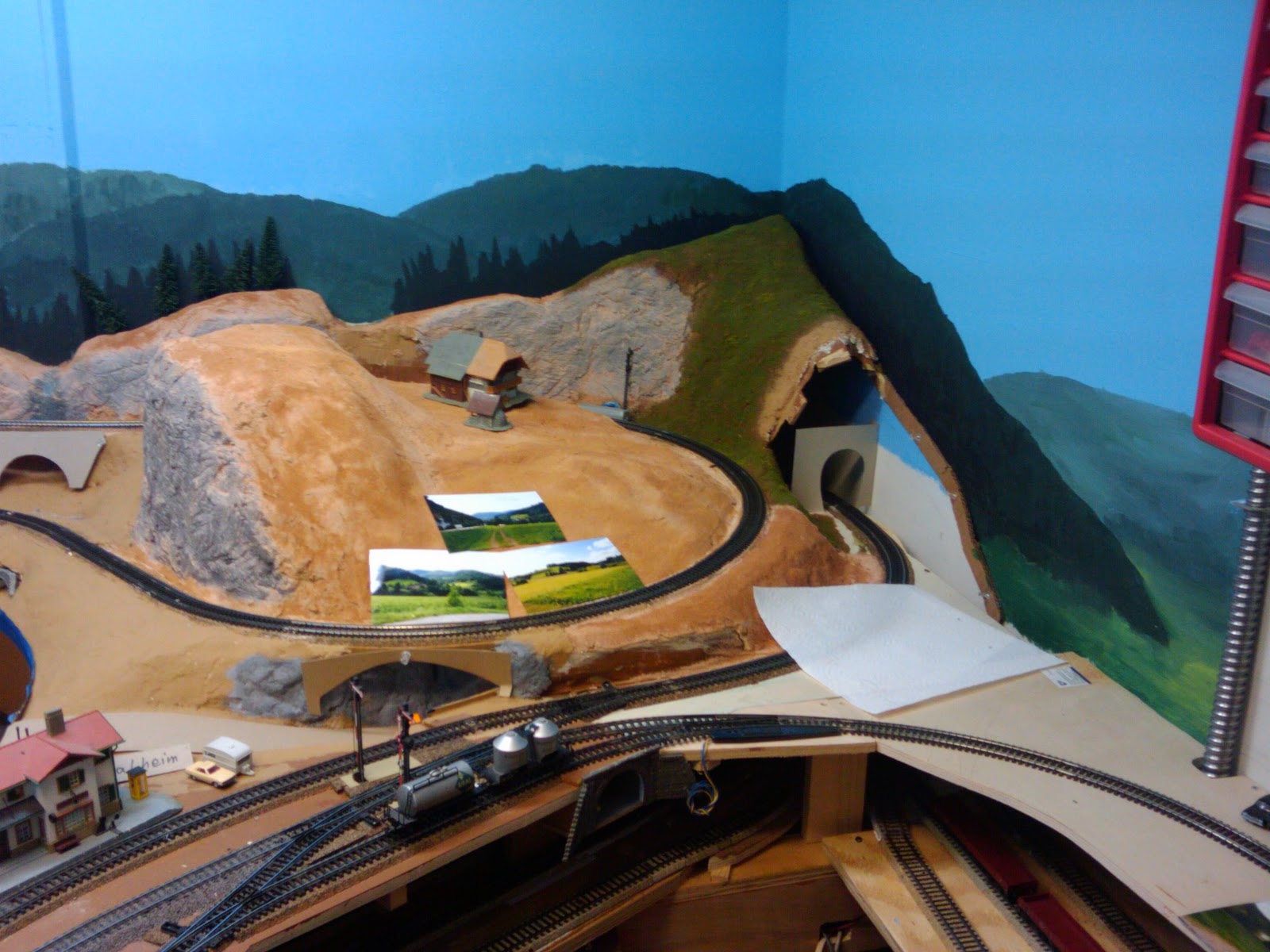
After quite a bit of searching I finally found the short circuit in the Emsingen power district.

It's here:


Can't see it? Here's another view:


Still can't see it? How about in this photo?
 

Yep.
I screwed up when I installed the track 9 months ago and didn't pay proper attention to the connecting latches between these two switches. One latch was bent so that it touched the rail when the neighboring switch was pushed down onto the track bed.
This only became a problem a couple weeks ago when I glued down the last track in Emsingen's freight area. I don't glue switches to the roadbed since they have moving parts underneath, so when the loose track seen in the first photo was glued down it pushed down the switch, which pushed down the rail, and made it touch the bent latch.
Ripping out the newly installed track didn't help, because the ends of the switch where tacked down during installation and got some glue, too, so the switch stayed in position. I'm actually glad it stayed put, since a persistent problem is a hell of a lot easier to debug ...


Using the continuity tester in my ampmeter and following the resistance readings, I was able to reduce the problem to the general area of the north switches in Emsingen.

I found the bad latch only after I clamped the leads to the rails and pressed on tracks and switches, as well as lifted them from the roadbed where possible until the beeping stopped.

At that point I could control the beeper by pressing on the joint, and I knew I had a winner.

Fixing it required some gentle force with a screwdriver to bend the latch out of the way.

Total Eclipse of the Moon in San Jose

This morning I got up a bit early, and took Pascal and Tatjana to see the total eclipse of the moon from the eastern foothills. The picture is a tad shaky (even though I used a tripod), and the camera / lens is not taking this well, but as can be seen in the picture ... the moon is indeed red.


A little bit later we drove over to Santa Teresa County Park, to see if I could get a better shot. Unfortunately by the time we got there the moon was so dark and low above the horizon that it no longer was visible.

However, the sunrise was quite nice.


Time to go home and have breakfast...

Friday, December 02, 2011

Sunday, November 27, 2011

"I'd like to watch some TV ..."

"... could you please bring my phone?"

The wonders of Mythmote.

Friday, November 25, 2011

When something goes wrong ...

... it usually happens in more than one place at a time.

The laptop I use as train computer developed a memory problem. The BIOS disables any memory above 88M due to a failure during POST. Yes, that laptop was quite slow, but it did the job, and has a beautiful, huge 1900x1600 display. Evaluating my options:

  1. I can go out and buy a cheap desktop computer, put it in the server rack, and run VGA/keyboard through the KVM to the 15" monitor at the rack. That would likely work out to be a DualCore or low-end i3.
  2. Ditto, but get just a low-end, low-power motherboard, and memory. One of the current pseudo-embedded CPUs, or Atoms, should do just fine. Install it in a spare computer case and put it into the rack.
  3. Try and make do with the 88M memory, convert the laptop to a dumb X-Terminal, (potentially remote boot it), and run JMRI on the server with a remote X session to the laptop. Technically a bit more interesting, a bit more involved, and actually not really something I'm particularly keen on. I get enough overly complicated setups at work.
I think I'm going to throw hardware at the problem, and go with either option 1. or option 2. and give up on the nice display.

---

The Emsingen power district of the layout developed a short circuit some time in the last 48 hours and I have no idea what caused this. The PSX circuit breaker is solidly reporting a short. All 3 PSX's LEDs flicker roughly  every 2-3 seconds, and the amp-meter shows an inrush of current at the same time. Evaluating my options:
  1. When I installed semaphores yesterday, something got on the track and is causing a short. I brushed down all tracks in Emsingen. No dice.
  2. Maybe a locomotive has a shorted out decoder, or some car is derailed. Removed all rolling stock from Emsingen. No dice.
  3. When I cut and glued down the north stub track next to the loading ramp on Wednesday, I somehow caused a short. Unlikely, but I ripped out this piece of flextrack anyways. No dice... Now that's annoying.
  4. I somehow jumbled track wires underneath Emsingen. No idea how that even could have happened. Did a visual check, and all connections look good.
  5. Powered off everything. Maybe the PSX just got confused. Nope, problem still there.
  6. Maybe the PSX is bad. Put the district on another PSX for testing. Still to do.
---

Patricia's computer developed an interesting file system problem. It appears that when the system stats some inode linked from her home directory, the operation hangs forever. This causes process like Nautilus or ls to go into state D+. I can kill -9 the process from another terminal, and get back the prompt. I can do tab completion (e.g. type ls .[TAB] and get a list of all files starting with '.'). I haven't tried every character yet. There are no hard disk related errors in dmesg. smartctl reports the hard disk recorded no internal errors either. I'm suspecting ext4 file system corruption, and will try an fsck next.

---

Bottom-line: What the hell is going on today?

Tuesday, November 22, 2011

Wireless stopped working ...

Out of the blue, wireless networking stopped working on our Dell Inspiron 1440. It runs Ubuntu 10.04 LTS, and no system update was performed before things stopped working. The Network Manager menu in Gnome shows Wireless Network Disabled, and Wired Network as Disconnected. Meanwhile other laptops in the house have no problem connecting to the wireless network, so this must be something local to this laptop.

In digging through Network Manager, iwconfig, iwlist, wpa_supplicant and friends, all I could come up with was that /var/lib/NetworkManager/NetworkManager.state lists WirelessEnabled=False. Manually setting this to True and restarting NetworkManager gets us plenty of log messages that show the device exists, and then gets disabled.

Finally, I realized that someone must have pressed the Disable Wireless button on the keyboard. Pressing it again resolved the problem. Sometimes it's the simple things ...

Monday, November 14, 2011

Mickey's Fantasmic! vs. World of Colors

Over the weekend I had the pleasure of watching both the "World of Color" show at Disney's California Adventure, and "Mickey's Fantasmic!" show at Disneyland back to back.

Both shows are very well attended outdoor evening shows, so getting there early (and getting the Fastpass for World of Color) is highly recommended. Both shows are good and fun to watch.

What struck me more, though, were the differences both in style and execution.

World of Color - California Adventure
Let's start with "World of Color". This show transforms the big lagoon at California adventure into a colorful spectacle of water fountains, mixed with movie scenes projected on screens made out of water. The execution was flawless. The color effects are mesmerizing. The fountains fantastic. However, to me it felt like this show was "built by committee".

World of Color - Movie projected on water fountain
The show started off with a season appropriate opener involving a Christmas theme. The fountains were colorful and impressive. From then on short sequences from well-known animated movies, old and new, played back to back with fountain sequences. Some sequences where upbeat, funny, others a bit scary, or dark. I'm still scratching my head why a segment from "Pirates of the Caribbean, On Stranger Tides" was included. The mermaids in the segment are really not Ariel-style family fare... At the end of the show I was both impressed and disappointed. The technical part of it was fantastic, but the whole thing lacked ... heart.

Mickey's Fantasmic!
After a mad dash from California Adventure we made it just in time to Disneyland's Rivers of America for "Mickey's Fantasmic!" . This show also uses water screens for movie sequences, but uses the Pirate's Lair island as a very effective stage for Mickey directing lights, fireworks, and fountains, as well as acting as background for the witch's magic potion scene and even a full-size dragon.

Mickey and the Dragon

Some movie scenes mix with live action of dancing princesses, Peter Pan fighting Captain Hook with the crocodile on their tail... and generally, compared to World of Color, less computer-controlled, more hand-made action. Even though (maybe because) Fantasmic! was a bit less polished, to me it had a lot more charme.


Bottom-line: Try to see both shows, especially when you're in the parks more than one day. Watching the shows back to back is probably only feasible during a slow week outside the summer months, because the viewing areas fill up quickly. Even last week, on a somewhat rainy day, many people got there over an hour before the show started to reserve good spots.

Oh yeah, it's very hard to take any halfway decent pictures of either show...

Sunday, November 06, 2011

Is that going to work?

On the workbench
Building a Timesaver in N scale is a little side-project. Above is the result of one long evening. The track is cut, and partially glued down. Let's see how this develops further ...

Saturday, October 29, 2011

Kalmbach Books now available in digital formats


Here's another publisher who is having a hard time adjusting to the digital age: Kalmbach, the publisher of the venerable Model Railroader magazine. I'm a subscriber of Model Railroader, and looking at inserts and ads in each issue, it's very obvious that Kalmbach is very good at recycling content from articles in different forms and trying to milk their customers any way they possibly can.

Recent example: The Model Railroader 75 year DVD set ... at a cost of $195. The biggest value here is being able to look up a certain article from a few years ago, but at almost $200 that's really not worth it. miba (the german equivalent to Model Railroader) is selling their 60 year collection on DVDs for 60 Euros, ie. at a cost equivalent to 4 digital yearly editions of miba on CD.

Another example: Kalmbach Books is releasing popular books in digital format by partnering with Zinio.  Take "Basic Model Railroading", an introductionary book to model railroading. Zinio charges $17.95, the exact same price as the recommended retail cost of the paperback version. Sounds fair?
Not really, no-one sells the paperback at retail price. It's on Amazon for about $10-12, and can be found new for as low as $5. While there's certainly some value to be able to carry around your railroad literature on a memory stick, is it worthy to pay more than street price? No, thank you.

And oddly ... I still prefer paper over pixels.

Friday, October 28, 2011

At night


I like this shot of the signals south of Blossom Hill in the headlights of an approaching train. I should come back with a decent camera and try to do this right. A cell phone camera in the end is still a cell phone camera...

The answer


Tuesday, October 25, 2011

Nothing new

Yep, there's not much going on right now with the layout. The "busy season" has started, and on top of that a lot of things are happening at work. That doesn't leave much time for modeling, building stuff or even running trains. I don't expect to get much work done on the layout until at least Thanksgiving.

However, I'm getting my fair share of running trains over the next week: SVL has the last ops session of the year on Friday, and I'm invited to an ops session at a local layout next Tuesday. Both should be fun, though likely quite different in how they pan out.
The following Saturday, November 5th, 12 noon to 5pm is Open House at SVL.


Monday, October 17, 2011

The Schedule

I designed the passenger schedule for the Welztalbahn around a few constraints.
  • The schedule would need to make sense in the real world. My operators most likely don't really care about this, since they are busy with getting trains and cars to where they are supposed to go, but I notice and that's what counts. 
  • Provide for some operational interest. I.e. make life a little bit harder for operators by setting up meets and having to think about train priorities and direction through Talheim interlocking.
  • Get in the way of freight trains and switching. 
Emsingen is the hub of activity on the layout, closely followed by the interlocking in Talheim. Above constraints led to the following principles:
  • Passenger traffic flows mostly between the big cities "surrounding" the layout area, as well as commuter service to Freiburg. 
  • Emsingen is "Eilzugstop" (i.e. the faster passenger trains stop only in Emsingen). 
  • Trains arriving from Prechtal via the (imagined) branch line either terminate in Emsingen, or continue on to Freiburg.
  • North-bound passenger trains to Prechtal can meet a south-bound Eilzug to Freiburg in Emsingen.
  • South-bound passenger trains from Prechtal can meet a north-bound Eilzug from Freiburg in Emsingen.
That yielded the following sequence of events:
PT = Prechtal, FR = Freiburg, ST = Stuttgart, TB = Tuebingen,  EM = Emsingen, TH = Talheim
(S) = running south-bound, (N) = running north-bound
  • EM switching
  • PT -> P 8114 (S) meet E 3577 (N) at Emsingen -> FR
  • FR -> E 3577 (N) meet P 8114 (S) at Emsingen -> ST
  • Ng 83271 (N) prep
  • Dg (S)
  • Ng 83721 (N)
  • ST -> E 3576 (S) -> FR
  • FR -> P 8115 (N) -> PT
  • Dg (N)
  • PT -> P 8116 (S) meet E 3555 (N) at Emsingen -> FR
  • FR -> E 3555 (N) meet P 8116 (S) at Emsingen -> TB
  • Ng 83720 (S) prep
  • Ng 83720 (S)
  • FR -> P 8117 (N) -> PT
  • TB -> E 3554 (S) -> FR
  • EM -> Ueb 97 836 (S) -> TH (Switching)
  • PT -> P 8118 (S) meet E 3579 (N) at Emsingen -> FR
  • FR -> E 3579 (S) meet P 8118 (S) at Emsingen -> ST
  • ST -> E 3578 (S) -> FR
  • FR -> P 8119 (N) -> PT
  • Dg (S)
  • PT -> P 8120 (S) meet E 3557 (N) at Emsingen -> FR
  • FR -> E 3557 (N) meet P 8120 (S) at Emsingen -> TB
  • TH -> Ueb 97 836 (N) -> EM
  • EM switching
There are still several flaws (e.g. meets in Emsingen are always the same direction, and there are no returning trains from Tuebingen), but I liked how the schedule left room for switching moves, and allowed for ebb and flow of traffic.

Saturday, October 15, 2011

Third Ops Session at the Welztalbahn

Today marked the first time the Welztalbahn saw an operating session with 3 operators. Although, ... it almost didn't happen.

I prepped for the session early this week, wrote a short description of the layout, its "history", and setting. I created scheduled trains. I did some (minor) staging. All that was left to do this morning was cleaning track in staging, and testing one or two trains that changed, and/or were known to be a balky. I also had set up a Chromebook with a connection to JMRI's mini-web server and planned to operate the turnouts in Staging from that. 45 mins of prep on the layout and plenty of time to get other chores done around the house as well. When I threw one turnout, hell broke loose...

LocoNet went nuts. One of the semaphore signals was being set to red over and over again, two turnouts did the same thing. I cut power to the stationary decoders. ... Deep breath. ... turn power back on, and it all continued. Power-cycle everything, and it still continued. Further debugging showed it came from JMRI Logix, but that didn't seem to make that much sense either. There's nothing in the Logix doing this. After ripping a lot more hair out, fruitless debugging, and contemplating to cancel the ops session, I realized this all started with when I threw a switch in staging which I haven't done since I added semaphores ... could it be ... 4x DS64, 2x SRC16 ... that they draw just too much power on the 12V DC bus? ... Indeed! That bus is powered by a wallbrick rated for 1A, and when the system comes live, there are short spikes of up to 1.5A, multiple DS64 charging their capacitors. Overloading the wallbrick can cause all kinds of funky problems.

Robert brought along a DC powerpack, things worked well with that, and the session could start. I took the mole job running staging, while Balazs manned Emsingen, and Robert took Talheim. We ran a total of 19 trains (out of 20 planned; BR50 didn't want to cooperate for the last Dg run). Aside from the BR50 issue, there where no mechanical problems, and no derailments! The session ran for abot 2.5 hours at a leisurely pace that left time for chatting on the side.

The operator positions are based on location.

Running Emsingen is mostly a switching job, sorting cars in the yard, switching the sidings in Emsingen, and swapping cars from the local freights. This position also includes running the Emsingen tower.

The Talheim position gets to run most passenger trains and freights on the visible portion of the layout, as well as operate the interlocking tower in Talheim. The interlocking can get a bit busy at times. For balance, towards the end of the session this position switches Talheim industries, while the Emsingen operator gets to run some trains.

The mole job is responsible for positioning trains at the staging exit for the operators to pick up, and storing trains arriving from the visible portion of the layout in staging. This position keeps track of the schedule and occasionally runs trains when the schedule asks for a passenger train meet in Emsingen.

Suggestions for improvement:

  • Better indication of direction. For both stations it's unclear which direction is North or South.
  • Prepare instructions for the individual trains that explain the required moves. Especially expectations about direction, station stops, and meets.
  • Better instructions for how to operate the interlocking panel.
  • Control all switches from the panel.
  • Explain color codes of trains and waybills somewhere.
  • Make sure to have English labeling for everything.
The sequence schedule I cobbled together worked surprisingly well. I'll have a separate post about that.

Overall, this session was a much bigger success than the last time, and everyone had a good time. 

Monday, October 10, 2011

More Backdrop Painting

When I got home tonight I needed to decompress and started painting more of the backdrop along the wall near Hochwaldtunnel. Not only did I feel a lot better when dinner was ready, but I really liked how the landscape now frames the layout in that corner.


So after everybody was in bed I cleaned up the edges of the existing backdrop painting and kept going around the rear corner almost to the tunnel portal behind the roundhouse. I'm quite happy with the result. Most of the painting in the rear corner will likely be hidden by the town of Emsingen, but I hope at least some of it will remain visible.  ... and if not, I can always paint the mountains a bit higher...


Wednesday, October 05, 2011

Jetlag


It seems I dropped my body clock somewhere on the East Coast on the flight back. In the evenings I rarely make it past 8:30pm, and in the morning I'm awake by 5am at the latest. Arriving in the office while it's not quite daylight yet ...


Sunday, October 02, 2011

Interlocking now working in Talheim

I finally completed the interlocking in Talheim, including working semaphore signals.

Here's a rough overview of how I implemented it with Logix in JMRI.

1) The panel: I built an actual panel with push buttons. All approach tracks as well as the station tracks in Talheim have a button. A route is requested by first pressing the origin, then the destination push button. The panel is built using a Team Digital SRC16 and connected to LocoNet.

2) Button state: When a push button is pressed, it causes a Loconet Sensor (LS) message and a respective Internal Sensor (IS) in JMRI is set to active, as well as a IS for "button pressed".

3) Route Selection: When the second button is pressed, the IS of the first button, the "button pressed" IS, and the LS of the button just pressed, uniquely identify the route being requested. For each route I wrote a Logix with the precondition of the respective sensor combinations. In the action part of the Logix, I trigger a JMRI route to line the switches, reset the "button pressed" IS, and set the interlocking internal sensors.

4) Interlocking: Each route through Talheim potentially conflicts with another route. There is an Internal Sensor for each valid route. When the respective Logix for a route is triggered, it sets the Internal Sensor for this route to active, and all conflicting routes to inactive.

5) Route Execution: The JMRI routes selected in 3) trigger the switch machines and line the switches. When the route is set, an Internal Sensor becomes active that indicates the route is set.

6) Signals: Each valid route has associated signals. When both the IS for the route is active, as well as the JMRI route sensor is active, the signal allowing a train to enter that route is set to Green. Since the interlocking sets routes to inactive, another Logix rule triggers on the IS of a route becoming inactive, and sets the signal to red.

Phew.

The logic works very well, and since the flow always originates with the panel and goes "downhill" from there, I don't think there are loops or races in the logic.

I have not yet implemented setting the signals to Red once a train passes, since I don't have the respective track sections wired up.

Sunday, September 25, 2011

Saturday, September 24, 2011

Laecheln!


An afternoon in Rems

There wasn't much water in the river. 

I like the many tones of green.

I never quite realized that his house on Hegnacher Strasse has this bridge mural.

Friendly company on this walk.

Friday, September 23, 2011

Swiss Accuracy


A train is not "about 15 minutes" late in Zurich. It's about fourteen minutes late. And we left pretty much exactly at 15:24...

Thursday, September 22, 2011

Eurowest 2011 BEMO Layout


This is a narrow gauge modular layout usually shown at the annual ETE Eurowest show. The lighting in the exhibition area was very bad, so the video came out a bit dark.

Haltbarmacherei

I love the name of these guys. Seen in Zurich.


Wednesday, September 21, 2011

Thinking of Transit agencies as Welfare Providers ... Really?


The Transport Politic has an interesting discussion about how to look at transit agencies and their respective subsidies. I'm disappointed by the conclusion of looking at transit agencies as welfare providers. Though, it is reality in today's America.

While it's not quite in the american psyche to consider transit as a viable alternative to the car, in the end change comes down to a chicken and egg problem, both in terms of supply and demand, as well as mind set both of planners and users.

Routes planned for today's usage pattern of the poor rarely encourage new users from more affluent neighborhoods. Placing transit stations on the median of freeways tells you something about the relative appreciation of transit users. Poorly timed transfers between transit agencies, and/or disparate fare systems, make using transit very inefficient, and yield nonsense like monster-long urban bus routes (e.g. in San Jose, Route 68 from Gilroy to Milpitas, or Route 22 from Palo Alto to Eastridge).

Furthermore, the true cost of daily automobile subsidies (yes, building roads costs money, too) and their relative cost to society (e.g. traffic accidents) is rarely discussed, and mentioned in the blog post only in passing.

However, I have very little hope that views on this topic will ever change in America. A clean, efficient, and fast public transportation system would be nice, and I'd use it. I guess my only option to experience that (again) would be to move back to Europe.

Monday, September 19, 2011

Tuesday, September 13, 2011

"I'll go back to the engine and see what's going on ..."

I stumbled over the railroadradio.net Web site a while ago. This is a collection of various radio receivers across the country and Canada providing audio streams of the communication between locomotive engineers and their respective dispatchers. The link above goes directly to the Caltrain page, which is a very busy railroad, so there are a lot of conversations going on. The sound quality of the radio transmissions varies a lot, some are extremely clear, others are choppy and very hard to understand.

On a late Tuesday evening one can hear three active trains: southbound 194 and 196, as well as northbound 197. One hears the engineers announcing arrival at stations, asking and getting track authority, as well as more unusual stuff like setting blue flag protection at San Jose Diridon, people walking on the tracks, or an engine failure of train 197 in Redwood City. "I'll go back to the engine and see what's going on there". 10 minutes later he comes back on, reports that "HEP is down, but the main engine is running again" and then asks for authority to proceed to San Francisco with the engine doors open. The HEP (head-end power generator) provides power for the cars. I.e. 197 is currently running dark with no lights, or air conditioning in the cars.

Saturday, September 10, 2011

Danny Macaskill at Ayshire Railway Preservation


Well  worth the time to watch the whole thing.

Kicker scenes:

  • balancing on a rail, ... and jumping to the other 
  • jumping on top of roof supports
  • riding on a crane steel wire

Monday, September 05, 2011

Effect of Cleaning Solar Panels


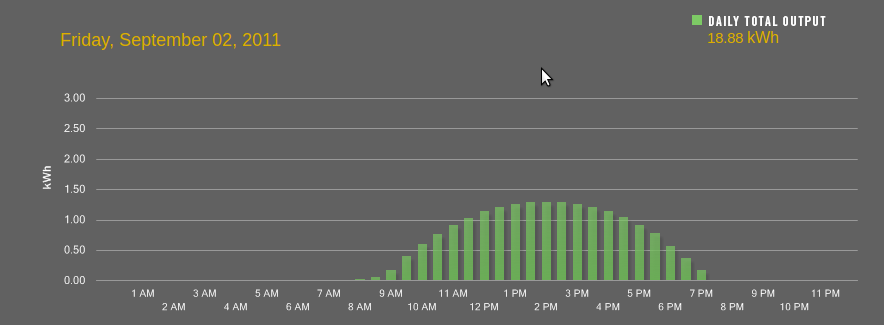
Saturday Pascal and I cleaned the solar panels. I was curious if there's a measurable effect of the cleaning. Conveniently enough, I have data to look at.

Here's the SolarGuard graph from Friday (which is quite typical for last week), a nicely shaped curved that closely follows light intensity over the day. We're topping out at ~1.3kWh around 14:00.


Here's the graph from Saturday. Starts out quite similar, ... 11:00 - 12:00 the sky was a bit overcast, so there's a drop in production, but when the sun fully came out again after 13:00 our production shot up to peak at just under 1.5kWh.


... and that wasn't a fluke as the graph from yesterday shows:


So, for us it's worth it to clean the panels once during the dry season. Over the winter we get enough strong rainfall to wash off dust and dirt.

Friday, September 02, 2011

Hungry rat causes short circuit at Stuttgart Hbf

Wow, this is hilarious. A hungry rat decided to munch on cables that power platform lights at Stuttgart Hbf plunging the main station into darkness for over 90 minutes.

I wonder if anyone took a photo of the dark main station...

Update:
Indeed, there are a few photos floating around. A pretty bad smart phone video can be found at bambuser.

Update:
YouTube to the rescue:


It's interesting how, after a few days, more and more content pops up about something as boring as a limited power outage at a train station. First the same article was linked from multiple places, then a few local papers and TV stations published their own versions, and finally user-generated content climbed high enough in search rankings to be actually findable.

Tuesday, August 30, 2011

Salad


Hass Avocado, Black Bean, Tomato, Red Onion, Cheddar Cheese,
Bread 'n' Butter Pickled Jalapeno, Red Pepper, and
Cilantro Salad with Cumin-Lime Vinaigrette, Sour Cream, and Tortilla Crunch.

Monday, August 29, 2011

Peek-a-boo


Roaring Camp's CF7 is waiting in Felton for its next assignment down to the Santa Cruz Boardwalk.

Monday, August 22, 2011

Some switching in the evening ...

Switching Emsingen and Talheim is a nice laid-back experience at the end of a day. Especially if -- for a change -- everything works. A lot of work items are idling on the to-do list, but I didn't feel like building stuff tonight.

I'm making up way-bills for any empty car cards that I encounter, defining at least the destination cities. If no specific industry is specified on the way-bill it's up to the operator to find a proper spot for the car at the respective stations. So far, car cards and way-bills feel more natural to me when operating the layout, compared to computer-generated switch-lists.


Best Buy: We're sorry


I went to www.bestbuy.com and got this. Why is that guy so friggin' happy that their Web site doesn't work?

Sunday, August 14, 2011

Feeling better

Last week was quite eventful at work, so I took it slow over the weekend, and spent time with family and building stuff.

Today's project: The tunnel tube.


Now that the tunnel portal is installed, I need an actual tunnel. Near the tunnel entrance I also want stone structure. I made a cardboard template of the portal opening, transfered it onto thin plywood, and cut it out. Rinse, and repeat. The stone structure is made from Faller wall paper. I didn't like the color of the stones, so I used black water colors to make the inside of the tunnel quite dark. I sealed the watercolors with some Dullcote. I'll use heavy black paper further back in the tunnel. After a few inches one can't tell anymore whether the walls have stone structure anyways.


Next, I painted the ground on the inside of the tunnel deep black. 


Yep, that's exactly the effect I was after. I might add some additional black paper later to extend the covered portion of the tunnel. However, this will also need to be removable for access in case of derailments and repairs.


Now that the tunnel is in place, I mounted the other side-wing from the Busch kit upside down. Except for the small portal opening I really like this kit.

After this photo was taken I started building the substructure for scenery down to the creek, and extending the creek to the inside fascia.

First tunnel portal

I've had mock-tunnel portals made from cardboard on the layout for quite some time. Today, the first actual portal was installed.


This is a heavily modified Busch 7022 "Dampflok Tunnelportal" I bought by accident a couple years ago. The original is made for steam engines -- no catenary -- so the portal height it is quite low, just over 7 cm. I cut out the original arch stones in the portal opening enlarging it to an inside height of 9 cm. Then I installed a Faller arch stone strip in the new opening. The left side of the portal wall is heavily trimmed for clearance with adjacent scenery. The retaining wall on the left, as well as the tunnel crown, is from the Busch kit, too. Judicious application of Scuptamold will integrate this with the surrounding scenery.

Saturday, August 13, 2011

Semaphores - installed

The north semaphores in Talheim are installed. Including covers. I used Polly Scale Aged Concrete for the base color of the cover, and will glue sand, ballast, and greenery on top. The idea is that the covers remain removable.


This afternoon the semaphores at Abzw. Talheim got their covers cut, as well as their wiring for the light bulbs. These semaphores were made for an analog Maerklin layout and the bulbs are wired to "light" and "ground", while the twincoils are powered from "light" to "ground".  With DCC decoders I don't have a constant on power source on the outputs, so I disconnected the "light" wire of the bulb from the twin coil machine, and instead wired in a dedicated 16V AC power source connected to "ground" of the semaphore body. Conveniently, the twin coil machine is insulated from the semaphore base, so I can easily keep those circuits apart.


The extra wires for the light bulbs can be seen to the right of the semaphore.

Monday, August 08, 2011

As much as I don't like paying taxes ...


"We as citizens don’t take enough personal responsibility for doing our part to pay for the basic services our government provides, and that we use every day."


Couldn't have said this better.

Friday, August 05, 2011

Reflection

It's strange how I find myself doing wiring work again, while craving for more scenery. It seems I automatically end up wrapping up projects I started a long time ago (detection, semaphores, route control) before opening up even more cans of worms.
Might also be that I unconsciously want to ensure the railroad runs well and is usable before diverting attention to more scenery. The long tunnel sections continue to bug me, but that's how this layout worked out, and I'm not going to change that in this setup.

---

Either way, the visible Talheim semaphore signals are mostly installed and wired. I decided to use both multi-position semaphores I have as entry signals for Emsingen, since using one in Talheim would severely restrict the available switching space before the tunnel portal north of Talheim.
I also started to wire up detection sections in Talheim. Some more surgery with the Dremel tool will be necessary to add gaps to all sections. for proper detection. Since most of the station area is made up of already installed flex track, and gapping bent flex track is yielding very unwelcome kinks, I will need to cut a rail at two switches. Not ideal, but should work out ok.

Tuesday, August 02, 2011

San Diego Model Railroad Museum


Most of the footage is from the Tehachapi layout.

Saturday, July 30, 2011

Kindergarten

The debt-limit "discussion" in Washington makes me sad.

This non-stop posturing for political gain on both sides (but particularly the Republicans) is so lame ... even Kindergarteners have a better sense for when to stop being silly.

Thursday, July 28, 2011

Semaphores

I couldn't resist. ... Talheim now has all semaphores selected, though not yet functional. Tonight I installed the two on the north side of the station.

Talheim north end
The twin-coil machines are installed into the roadbed to hide them a bit from view. Where space is tight between tracks, I dug the hole even a little bit under the track. I will fit a piece of styrene over the opening to protect the machine from landscaping, dust and dirt. Yet I'll try to keep the cover removable for maintenance.

Twin-coil detail
Exit signals at the north end of Talheim
These signals are about 30 years old, and even though they are definitely not up to modern detailing standards, they look reasonably good.

Yes, that Roco 211 still needs detailing...


Wednesday, July 27, 2011

Talheim Local Panel - part 5

The remaining buttons are now connected, and I can finally reset a badly chose route before throwing it with the left black button in the back. The black button right next to it will be used to toggle whether to set signals, too, when setting a route.

One minor snag is that the cross-overs at the bottom don't throw consistently in unison as I press the button to toggle them. I'm not sure yet if the computer is sending the turnout commands too fast, or if the commands get lost. However, since I'm experiencing zero problems with other turnouts, and it's always the same turnout that doesn't toggle, I think communication is fine, and JMRI is sending the turnout commands a little bit too fast for the Tam Valley servo controller to handle. JMRI routes allow to add an extra delay between commands when executing the route, so I'll try that later tonight.

I'm very tempted to pull out the semaphores and connect them, even if only temporarily ... It would substantially change the look and feel of the Talheim area, and would be really cool. Hmmmmm...

Update 23:00:
My stupid perfectionism found a few issues:

  • The old signals need a color refresh. Particularly the red color on some of the semaphore arms is in sad condition.
  • To my utter surprise I'm short 2-3 signals. Had I realized this earlier, I could have picked up a few real cheap last weekend at Eurowest... However to my delight I noticed that there are two signals that can show Hp0/Hp1/Hp2. Those will be used as entry signals to Emsingen, and/or maybe Talheim. Though for Talheim I can pretend the entry signals are inside the tunnel.
  • The semaphore masts feel small, but it turns out that a mast height of 10.5cm above the bottom of the rail works out to just over 9 meters in HO which is right in the middle of the prototypical heights of 8 or 10 m. I'm mounting the semaphors lower than intended to partially hide the huge Maerklin twin-coil machines in the base.
  • In some locations the semaphore arms are partially above the neighboring track. My literature says that is prototypical as well. Tough one location in Talheim is very tight, and the prototype would have used a different kind of mast with tracks that close together.
  • At least one track in Emsingen needs the semaphor location adjusted by a few centimeters.
Just toggling the cross-over turnouts in Talheim doesn't give reliable results, apparently because the QuadP can't handle the turnout commands right after each other. Adding a delay helps, but it looks like there's a race condition around releasing the sensor button, so the logix still didn't work correctly.

I broke up the one logix into three: One logix to toggle an internal sensor based on the pushbutton sensor going active, and one logix each to explicitly set the turnouts to thrown or closed based on the state of the internal sensor, including a small delay between the turnout commands. That works very reliably, and I couldn't get the turnouts to go out of sync any more.

Sunday, July 24, 2011

Talheim Local Panel - part 4

Yup, still spending time on this. Tonight I finished up the basic JMRI logic, and even came up with a way to conditionally throw signals as the routes are set based on the state of a sensor. As usual apparently I'm over-engineering this ... again. Oh well, we'll see how long this one will last.

Saturday, July 23, 2011

Seen at Eurowest 2011


To bad this was the only signal I could find on the whole layout, and it was always green :-)

Thursday, July 21, 2011

Talheim Local Panel - part 3


It's starting to come together. The bad push-buttons are swapped out. The buttons for locally controlled turnouts are added, as well as the LEDs put in place for show (though not connected yet).

Wednesday, July 20, 2011

Push-buttons

I cleaned up the remaining mess from the 63400 testing. All systems are back to go, ... well, with the exception of the Talheim panel. The push buttons are in, plus some LEDs, electronics hooked up, too.

I'm now writing the routing logic in JMRI to get two-button routes. I.e. the way it works is that the operator presses one route button on the panel to start the route. Then another route button for the end of the route, and JMRI will align the switches (and later semaphore signals) accordingly. Since Talheim has tracks going into 5 directions there's no way to use the more regular way to control turnout ladders with a single button per route.

Some of the cheap push-button switches I use are already breaking, partly because I need to be really careful when soldering wires to the connectors, since the casing is plastic and easily melts, displacing the contacts inside. So annoying.
Does anyone have a source for reliable push-button switches that don't cost the world? The ones I use right now are similar to these.

Thursday, July 14, 2011

Google Apps transition test

I completed transition of my Google Apps hosted domain to Google's new authentication system. This is a test post to make sure, Blogger still works with the new credentials.

Tuesday, July 12, 2011