What do you do when you are uncomfortable with new payment options banks push on you? You ... fix ... the card.
Phil Parker is showing how to do this with a Barclay's PayTag card in his workbench blog:
http://philsworkbench.blogspot.com/2012/05/barclays-paytag-vs-modelling-tools.html

Wednesday, May 30, 2012

Thursday, May 24, 2012
How the Welztalbahn developed over the last four years
I'm building the Welztalbahn layout for about 4 years now.
 |
| Spring 2008: It all started with a platform in the garage |
 |
| Spring 2009: Hidden staging level and ramp to middle level are built. Also, I'm already toying with computer control. |
 |
| Spring 2010: Track on the middle level is almost complete. First scenery ("the creek") is in. |
 |
| Spring 2011: The main line is functional through all 3 levels. Most tracks are in. There's scenery, even some background. |
 |
| Spring 2012: More scenery, signals, and a tested operating scheme. |
Monday, May 21, 2012
Steinlehof

What difference a little bit Green and removing protective tape makes. The road is unfinished painted Scuptamold, but works surprisingly well for this photo. I have a design for Steinlebruecke in mind which will be a wooden span over the track in the background. There's a good chance that I'll build that bridge in place because of the odd angles to support the height difference to the forest road.
There's a bunch of details missing, but I'll get to that some other time. Next up on the list is cleaning up the layout and making it operational again.
Sunday, May 20, 2012
Grass
Work in progress at Steinlehof.

Me and the Grassinator made food for the cows. For now the cows enjoy their free roaming space. Eventually there will be fences, so the cows don't graze on the train tracks.


Me and the Grassinator made food for the cows. For now the cows enjoy their free roaming space. Eventually there will be fences, so the cows don't graze on the train tracks.

Partial Solar Eclipse in San Jose, CA


 For today's partial solar eclipse I made a pinhole camera, so we can see the effect without risk of causing permanent damage to our eyes.
The partially obscured sun created really awesome, freaky half-round shadows of leaves.

With the right settings on the camera and the help of a welder's mask, one can even get a reasonably sharp picture of the obscured sun.

Saturday, May 19, 2012
Makerfaire

 |
| Whiskeydrome |
 This was our second visit to Makerfaire. Just like last year the event is overwhelming, exciting, and fun, all at the same time, and everyone takes home different impressions and new ideas.
One can spend most of the day walking the booths in the big Expo Hall alone. Notable booths and things we liked the most:
 Building a foam rocket. Pascal enjoyed building and launching a rocket made of foam pipe, duct tape and foam sheets.
In the South Lot were plenty of odd contraptions (partially) made of bicycle parts, that where plenty of fun to ride.
The WhiskeyDrome guys were back. Roland, Pascal, and myself watched for quite a while. They even ride hands-free! Awesome.
The Crucible Village. They showed a truck that had 8 remote-controlled fire blowers installed on the bed. Gas. Fire. Heat. What else can you ask for?
 |
| Levitating Fountain |
Pascal was fascinated by the mechanical pinball machines of the Pacific Pinball Museum.
After a quick lunch (and waiting a long time in line to get to the order window), we explored the "dark hall", which featured a demonstration of Intel's Computer Controlled Orchestra . I saw part of the performance when we got into the hall. When they got ready for the next one, I got the kids, and brought Pascal to the front of the crowd surrounding the installation. He watched the whole thing almost motionless. Afterwards, he said: "That was so cool. Unbelievably cool."
 Operating and modifying MATE's Underwater Robots kept Pascal busy for a long time, just like delving into playing with Bloxes a few feet away.
Gon KiRin is a kinetic dragon sculpture that spews fire, and you can climb on it, in it, even lounge on couches. When we walked along one side, one of the guys winked Pascal and Tatjana over and told them to press The Button. ... Pascal pressed it first and out spew a 10 ft flame from the dragons mouth! Pascal's face lit up, and he pressed The Button again. And again. So much fun.

 As was building your very own toolbox from sheet metal at the booth right next to the Coke and Mentos stage.
We spent most of the day at the Faire, and everyone had a great time.
Monday, May 14, 2012
"Des koennen sie alles senden was ich gesagt hab"
Ich mag den Seehofer ja nicht so unbedingt, aber das hier ist klasse:
Saturday, May 12, 2012
Hiding the semaphor machine
I'm using old-style Maerklin semaphores for my signals. The masts are attached to a dual-coil switch machine which is quite bulky. In station areas I managed to hide them between the tracks and lowered them into the roadbed.
However, Emsingen's entry signal A is out in the middle of the forest, and I do need the machinery to be accessible for servicing. In this case ended up fitting a sheet of styrene over the space, brace it with some wood, and cover the ends with stone sheet.


Placing the cover at the signal showed that I didn't get the cutout for the mast quite right and had to enlarge the hole. I'll put a telephone cabin in front of the hole, so that it's not quite as obvious. Yes, this is actually one of the triple-coil semaphors, so the cover needed to be quite big.
Update 2012/05/13:
I painted the base and topped it with a thin layer of fine sand. Looks much better than the stark white of styrene.
The telephone box looks way out of scale. I wonder if this was a N-scale kit...
However, Emsingen's entry signal A is out in the middle of the forest, and I do need the machinery to be accessible for servicing. In this case ended up fitting a sheet of styrene over the space, brace it with some wood, and cover the ends with stone sheet.


Placing the cover at the signal showed that I didn't get the cutout for the mast quite right and had to enlarge the hole. I'll put a telephone cabin in front of the hole, so that it's not quite as obvious. Yes, this is actually one of the triple-coil semaphors, so the cover needed to be quite big.
 |
| Test fitting. |
 |
| Cover painted and topped with a thin layer of fine sand. |
The telephone box looks way out of scale. I wonder if this was a N-scale kit...
Saturday, May 05, 2012
Making the road narrower
 |
| Narrower access road. |
Looking at the access road today, it feels like I'm building a German Autobahn through the Black Forest, or at least a major two lane highway. I contemplating ripping out the access road and starting over, but before I did that I traced a narrower one lane road on the existing shoulder and used a hobby knife to cut through the Scuptamold-tape-cardboard contraption along the edge of that narrow road. Next I simply cut off a few millimeters of material, straightened out the edge, and voila ... this looked much more like what I had in mind.
The first photo shows the new road after I made the cut and re-arranged the slope. The former edge of the road is half-way down the embankment now. The second photo shows the situation after patching up the cut with Scuptamold.
 |
| Embankment patched up. |
Friday, May 04, 2012
Steinlebruecke
While in Zurich my Dad gave me a great idea what to do about the access road to Steinlehof after it crossed Steinlebruecke. The elevation change between the forest in the background and the Steinle area on the other side of the tracks is almost 2 inches, which would have resulted in a very step, odd-looking bridge.
Instead, I built up a shoulder along the hill, which raises the access road to almost the same height as the forest. Since this doesn't have to support any weight, this is made from cardboard with some styrofoam bits underneath and covered in masking tape and Scuptamold.
When I filled in gaps around Steinlehof the last time, I left the building in place while the Scuptamold dried, which basically glued it in place. I didn't install lights, nor painted the building yet. Ooops.
I managed to do touchups and paint the roof and most walls with the building in place. This took care of most of the plastic sheen and visible glue spots that bothered me. I will cut a hole from inside the hill to place some light inside the living area of Steinlehof.
Time to start thinking about a design for Steinlebruecke.
 |
| Building up a shoulder along the hill for the Steinlehof access road |
 |
| Access road covered in Scuptamold |
 |
| Looking north from Emsingen towards Steinlehof. In the back the Emsingen entry signal |
 |
| Looking south on the dark side of Steinlehof. This view is only possible from camera |
Time to start thinking about a design for Steinlebruecke.
Sunday, April 29, 2012

Dolderbahn
The Dolderbahn is a cog wheel railway going from Zurich-Romerhof to Dolder Bergstation. While there's not much interesting up there for tourists (unless you're into super-expensive hotels), the view is quite nice. Here's a shot of the snow covered Alps taken from Dolder Bergstation.


Saturday, April 28, 2012
A very windy place
 |
| The view from Uetliberg was great, though the wind was very strong. |
 |
| On the way back down from Uto Kulm to the Uetliberg train station. |
Friday, April 27, 2012

Creating a Quick and Dirty Operating Scheme
 |
| "A"-Town on the right, "D"-Town between the two potted plants |
During automated operation, the layout is treated as a mostly double-tracked loop, with two single track choke points and one large interlocking that allows trains to run return loops, or take short-cuts.
 |
| Industry tracks are labeled with sheets of paper in "D"-Town |
For each industry track I defined what kind of car type the track would accept. I chose a distribution of car types that roughly matches the fleet Balaszs has. Due to space constraints, most "industries" are single or double track spurs, mostly off sidings. There is one large industry with a more complex track arrangement.
To create a feeling of location, I gave each industry a name, as well as town names (well, the town names are not exactly imaginative: A, B, C, D, E, and F arranged roughly clockwise along the loop of track). Once that was worked out I placed sheets of paper near the tracks indicating location, industry, and what kind of cars the track would accept.
A small, stub-ended classification yard existed already. We added a dedicated track to be used as yard lead to disentangle the lead from the single A/D track.
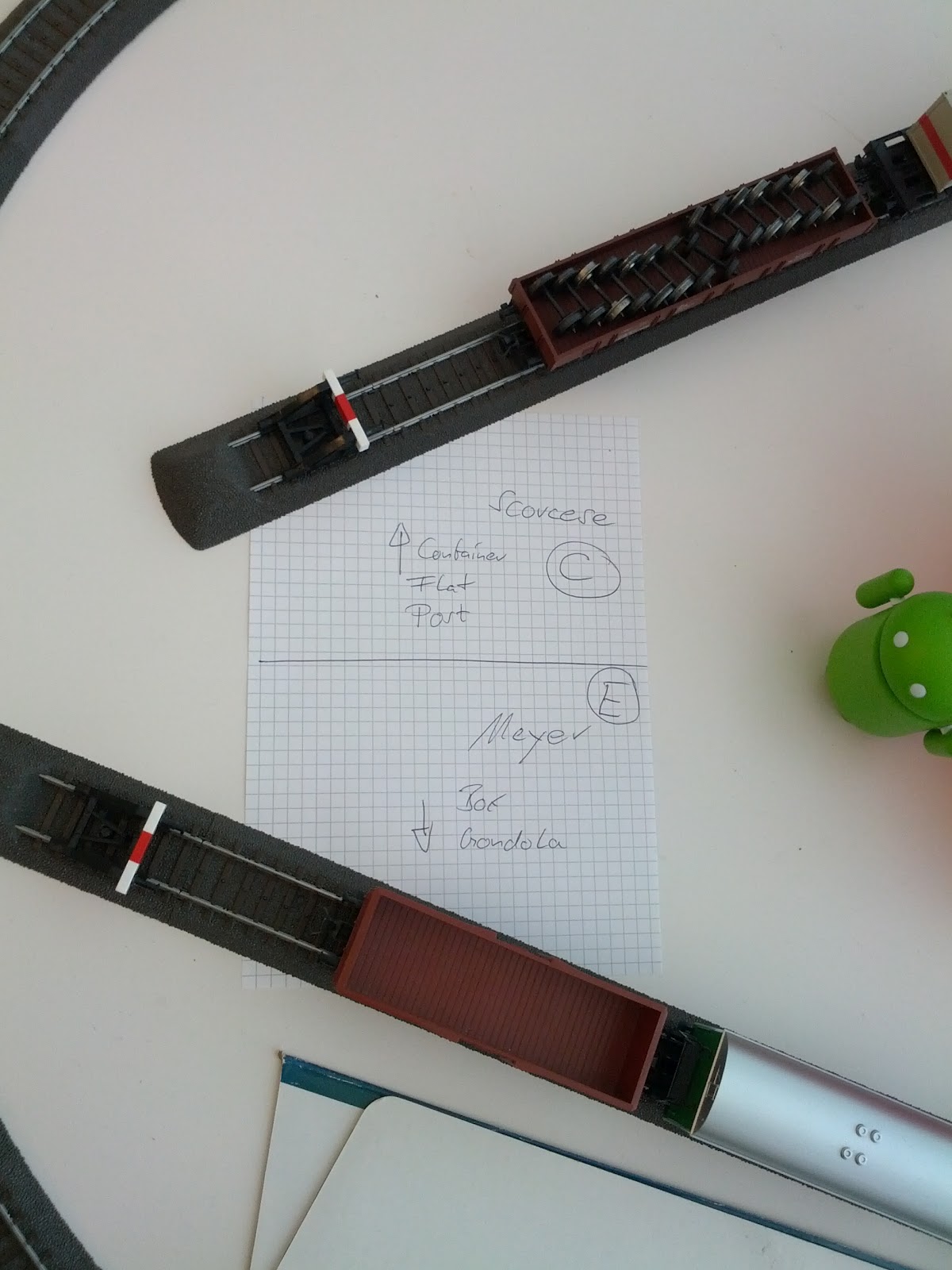 |
| Industry tracks of "C"-Town and "E"-Town |
Now that we had industry locations and respective tracks, it was time to define trains. There are almost 30 car spots, maximum train length is about 8 cars, and multiple operators are expected to work the railroad. There will be local freights, through freights, as well as extensive passenger operation.
I broke up the local freight operations into 3 trains. One would run from the Yard to towns A and B, one would cover towns C, E, and F, and finally there would be a dedicated run to switch the large industry in D.
To extend the length of the runs, and make the job of a dispatcher a bit more interesting, the local freights need to go all the way around the layout between switching two towns. All trains are turns, so the engineers need to pay attention to trailing and facing point turnouts in the industries to switch, and in the worst case run around their train on a siding as needed. For each train I wrote station/loop order on a sheet of paper, so that the operators know what's expected of them.
Car routing works by type of car. If a track asks for a box car, any box car the train brought along from the yard will do. The engineer is expected to keep track which cars he picked up at an industry on the way and make sure to bring them back to the yard. However, even if a car or two slips through, it doesn't really matter that much.
This operating scheme was developed over the course of about an hour, and we ran a session with all 3 local trains, plus classification in the yard the same evening. There's certainly room for improvement and fine-tuning. However, for something that was made up on the fly, I was pleased to see that it worked well enough to give a feel for how switching on the layout could work, as well as quickly identify areas both on the layout and operationally that need further refinement before investing a large amount of preparation time.
Plus, we certainly had fun, both building out industries and track arrangements, as well as operating ... In the end, this is a hobby. Enjoying what you do is the only thing that matters.
Thursday, April 26, 2012

Wednesday, April 25, 2012

Tuesday, April 24, 2012

Subscribe to:
Comments (Atom)