Saturday, August 25, 2012

Wilderness & Survival Skills Class @ AdventureOut

AdventureOut is offering survival classes in the Santa Cruz Mountains. Pascal and I got to enjoy the class today. Mark and Jack are great instructors and both of us had a lot of fun.

Pascal tests our (incomplete) debris hut.
Making fire.  This is really hard work for a nine year-old.
First time I actually made fire with a bow drill. 

Yay, I have a tiny coal. Let it smolder ...
... and pack into a nest of yute twine.
Smoke ...
... and fire. Ouch! This is hot!
... and quickly throw it into the fire ring.

Background


I should really be doing something else, but it felt good to paint more of the backdrop tonight. Compare to what this looked like before. Most of the distant "hills" above the tree line on the left-hand wall will be painted over with sky.

Monday, August 20, 2012

Hinteraecker

Here's my materials list for basic ground cover at Hinteraecker.


First I added a coat of fine green flock directly on the still wet "brown dirt" paint.


The next step is messy, so we enter "cover up everything land". Some 70% alcohol as a wetting agent, followed by a generous application of scenic glue (aka matte medium), topped with static grass. I tried to create a lush, unkept appearance for the grass on the hill making room for a more dried up look between the tracks.

If you look closely, you'll notice that I also installed the south entry signal for Emsingen, completing signal installation on the layout.


Sunday, August 19, 2012

Kopper sidings

I was not happy with the track arrangement around the Kopper furniture factory. Particularly the track to Gregorius Wood looked awful. You can see a good shot of the area in an earlier post.
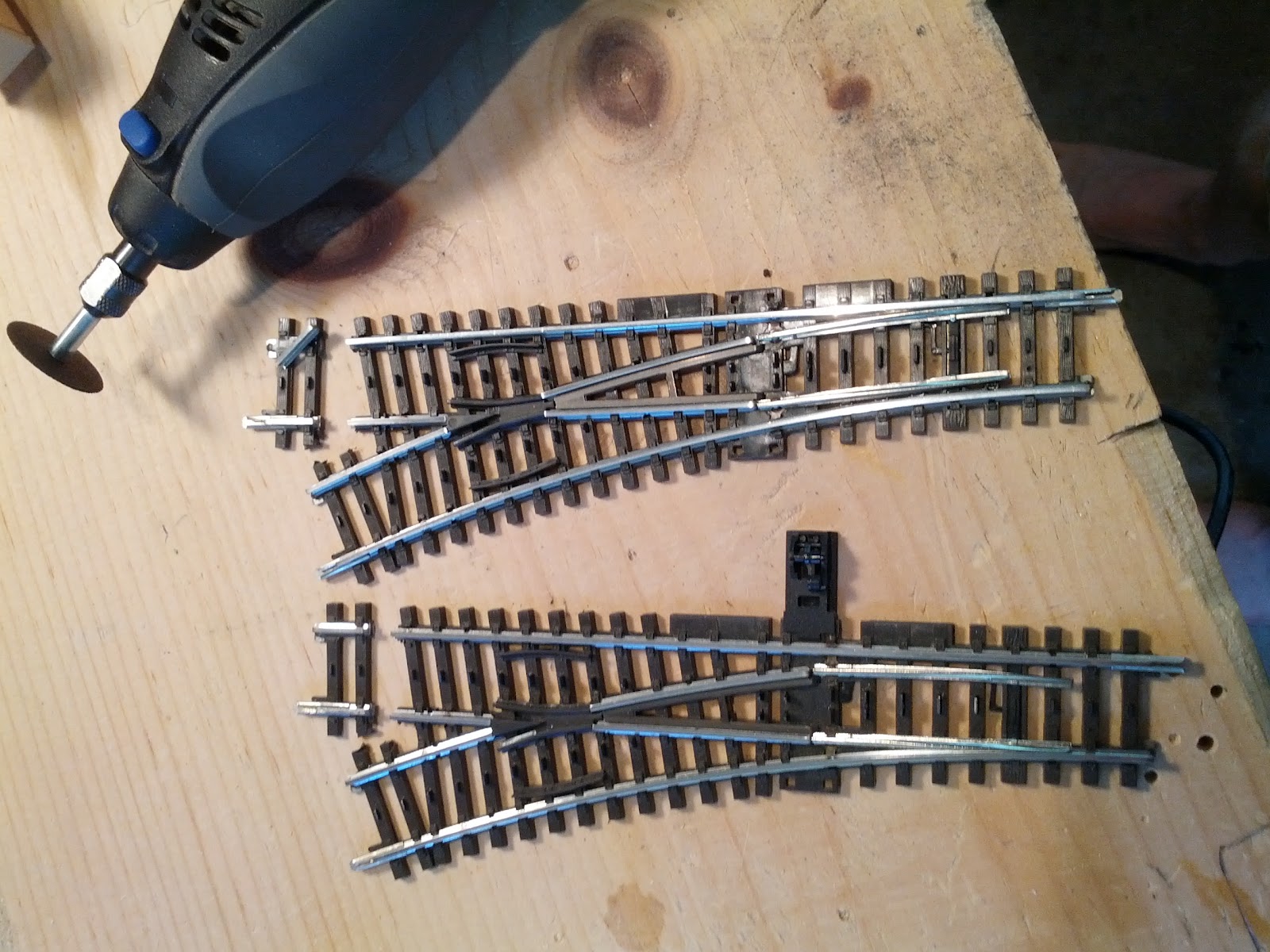
Dremeled turnouts

I had several issues to deal with:

  • Since this is a trailing point siding, I need substantial amount of track to pull cars. Ideally enough track to pull all cars from the siding with one movement.
  • The curve right after the turnout is sub-optimal.
  • I can't go straight out of the turnout, since I'd run off the baseboard, or get really close to the edge.
The cut turnouts put together
The solution involved shortening the stock Maerklin turnouts using a Dremel with a cut-off disk. 

This had two nice effects.
  • It moved the divering legs of the turnouts closer together, and I gained just enough space to now run the Gregorius siding straight out of the turnout.
  • By reducing the length of the turnouts, I gained just enough space between the switch and the end of track to fit the length of the siding, plus a Koef switching locomotive.


The overview shot below nicely shows the positive effect this small change had on the track layout in the area. You can also see the smal triangular piece of plywood I added at the very end of the pull-out track to gain a whee bit more track length all the way to the edge of the layout entryway.


The only catch is that I had to cut some of the electrical connections in the turnouts for this to work, and the joint is very fragile. I'll need to wire the siding and pullout track separately, but that was planned anyways, so nothing lost here. The pullout track will double as team track during operating sessions.

Saturday, August 18, 2012

Fascia done

The fascia is completely installed and painted.


I really like the effect of the fascia in the last photo. Access to staging is a little bit more limited now, and I will have ... fun ... installing the turnout motors when the time comes, though it's all manageable and worth it.

Fascia for Talheim


Doesn't this look really unfinished? ... Yeah, I thought so, too. Last week I installed the last mainline turnout motor in Talheim, so I can finally think about making this look a bit nicer.

 Hardboard (or even better tempered hardboard) is a good material for building the fascia. It's quite sturdy, yet flexible, easy to cut and easy to work with.

I went a little bit over the top with this section of the fascia. Just had a whee bit too much fun designing the shapes.

Though, I think the result is worth the effort, and it frames the railroad a bit more. I need large openings for access to hidden staging which disturb the frame effect quite a bit. There's always a compromise in this somewhere.


Roundhouse

I didn't like the red plastic walls inside the roundhouse. Neither did Pascal. So I went in and painted the inside in PollyScale "aged white", which really means "very light yellow". Since I used a brush (and should have done this at the very beginning of this project with an airbrush), and the "white"  doesn't really cover the plastic that well (and I should probably have primed it before putting the walls together), the question of texture on the walls resolved itself. It'll be brush marks, and I'll do better next time.


Above photo also shows the beginning of interior lighting for the roundhouse. These are Micromark 12V grain of rice miniature lamps mounted in sockets that came with the roundhouse kit. I keep thinking about whether I should add inspection pits. I'd really like that, but going through the trouble with the center pickup is just not worth it. Since this is inside the roundhouse, what I will do instead is to cover the ties with very thin styrene painted in the color of the roundhouse floor. The inspection pits will be represented by an area without this styrene "floor" and I'll paint the ground and ties black. That should get enough of the "there's a hole in the ground" effect I'm looking for, and when the roof is on you can see this only through doors and windows anyways.

Speaking of roof ...

The roof is still missing the smoke vents above the engine stalls
Ef tower with roundhouse in the background
Roundhouse, Ef tower, and the future Emsingen station building

Tuesday, August 14, 2012

Turntable pit

While the ground behind the tracks dries, the turntable pit support gets its final positioning.


The base board is 1/2" birch plywood. My Roco turntable needs a slight bit of space all around for the indexing to work properly and at the same time requires all the support it can get. The piece of 1/8" hard board has been positioned and marked before I moved the whole arrangement to the work bench, with all the track and buildings marked as well. After the hardboard is solidly in place, I'll build a support bracket for the turntable to rest on, so that there is no way it can sag and bind under even the heaviest locomotives.

Sunday, August 12, 2012

Emsingen Hinteraecker


Emsingen Hinteraecker isn't really modelled on the layout. Hinteraecker is the area behind the maintenance facility and represented mostly by some fruit trees, some grass, a few decidious trees and bushes along the tracks. I will try to paint a small field on the backdrop. We'll see how that works out.

The ground is my usual mix of 5 parts vermiculite, 4 parts plaster of paris, and 3 parts water, plus Tempera powder paint (adapted from Joe Fugate's video series). Instead of brown, which turns into a redish tone when mixed with the plaster, this time I tried black. Two spoons of black tempera is one spoon too many.

I will completely redo this section of the backdrop.


Saturday, August 11, 2012

Kitchen Faucet

A couple months ago multiple people managed to unscrew the whole faucet from the sink, merely by moving the faucet arm back and forth. At first I thought, "what the ...?" , but after a while it became apparent that there's something wrong with the faucet itself.

Today, I took the whole thing apart.


I knew from some initial observation two weeks ago that a rubber gasket inside the faucet was stuck between the grey plastic piece and the outside wall of the faucet. Turns out, there are two of those suckers... and they were ripped to pieces.

There was also quite a bit of gunk built up around the brass pieces. I'm guess from water that got inside the handle and evaporated there leaving behind calcium deposits (Thanks to our hard ground water...)

I cleaned that out all out and replaced the gaskets with new ones from a somewhat generic Delta repair kit. Hopefully, I picked the right ones, at least it all went back together nicely ... with some swearing, until I realized I need to use the skinny gaskets from the kit.

I don't claim I have any idea what I'm doing here. While at it I also cleaned out the pipes and trap underneath the sink.

Let's see how long this will last.


Friday, July 27, 2012

Roundhouse shell

The roundhouse shell is complete.

Some work benches and tool cabinets are in place
So far, so good. After looking at the photos for a while, I decided that I'm not happy with the look of the exposed plastic. Never would have thought that I'd get this anal about the inside of a building that will be located towards the back of the layout room.

There needs to be an easy way to simulate a somewhat dirty off-white brick wall for the inside of the roundhouse. This would have been easier with the walls off, but I figured it won't bug me that much. MEEEEK! ... Wrong.

At a minimum, I will just paint the inside red walls with some off-white color and "dirty them up" during installation of the roundhouse tracks. No brick texture, but better than these red plastic panels.

What are options to get some texture on these walls? It needs to be easy to cut and install, and should take paint well (if not in the right color already). Some kind of wall paper, maybe?

Wednesday, July 25, 2012

Roundhouse progress

The roundhouse is starting to come together

With the window frames in, the mortar doesn't look quite as bad anymore

The inside is getting some furniture, including an oven.
Inbetween tasks and work, I'm slowly making progress on the roundhouse. I contemplated (and tried using posterboard) to give the inside walls a more finished look, but then decided against it. It's a lot of work for minimal gain. Maybe I just paint the walls using a dirty off-white color. The inside of the roundhouse will have lights, so I'm hoping that will be sufficiently effective.

Nightsky over Zion Canyon

Sunday, July 22, 2012

Emsingen Ef

Testing placement of Emsingen Ef
I always had a weak spot for this Faller "Reiterstellwerk" model. It's not exactly one of the most authentic towers out there, nor does it fit perfectly at this location, but I couldn't resist when I saw it at a dealer's table at Eurowest yesterday. This tower will be called "Emsingen Ef" for Emsingen Sued, Fahrdienstleiter, i.e. it's located at the south end of the station and the dispatcher for Emsingen works in this building.

The levers ("Hebelbank") are in the bridge part of the tower, so this couldn't be a purely mechanical tower. There's not enough space underneath the floor to run the actuator wires. However, it's feasible as an electro-mechanical tower, where the levers electrically actuate signal and switch machines in the basement on the right, which then move signals and throw turnouts.
I'll place a small tower ("Emsingen En") on the north side of the station to guard the railroad crossing and operate nearby turnouts and northbound signals. Admittedly, two towers is somewhat overkill for a station the size of Emsingen, but there does need to be at least an attendant shed at the crossing to ensure vehicle traffic is safely off the tracks.

To properly set Emsingen Ef in place, I need to level the ground and cover up the semaphore machines, as well as add some lights at least to the bridge part of the building. I hope illumination will show off the Hebelbank, especially at night.

Aside from the tower, I also bought background buildings for Emsingen, and some additional detailing for Emsingen station.

Wednesday, July 11, 2012

Patina


A new project. I might have overdone the mortar a bit, but will tone it down a bit in the final stages of assembly. Really looking forward to building this model.

Tuesday, July 10, 2012

That pesky curved turnout

I mentioned before that the curved turnout on the ramp from staging didn't want to play ball with BR24. Today I ran that locomotive over the spot where it got stuck consistently two weeks ...uh, a month ago, and sure enough, just like last year, no problems anymore.

However, since BR24 has the pickup shoe below the locomotive, and the loco frame is quite a bit more open than the tender of BR50, I could actually observe what the pickup show is doing as it glides across the turnout. At one point, right above the pivot of the turnout points, the pickup shoe drops and then gets lifted up again.

Even closer observation showed, that there is potential for the pickup shoe to slip off the raised point contact in the area, and then get caught in the next middle contact.


To work around this problem, I super-glued a small piece of styrene into the turnout that should keep the pickup shoe out of the "hole" and in line with the top of the point contacts. The ramp from staging comes from the right.

Yes, all of staging is built with Maerklin M-track.

Sunday, July 08, 2012

Emsingen Southbound Semaphores


The southbound semaphores in Emsingen now also have power. Stationary decoders are installed, and I should get around to wiring them up in the next couple days. All the JMRI routing logic is already built and ready to go.

Christoph

Switching cars in Talheim

Saturday, July 07, 2012

"Paneling" ...

Panel for stub-ended staging and ramp cross-over 
... or what do you call the process of building panels?

Today I finally built the panels for controlling the turnout ladders in hidden staging, as well as the hidden cross-over on the ramp.

I didn't bother with turnout position feedback on these panels since I eventually will have a monitor on the wall that shows turnout positions, occupancy, and maybe even a live video feed of the traffic on the ramp. Also, all these turnouts are driven by solenoid motors, so there's a satisfying SMACK whenever they throw, so you know you hit the button right. I'm using push-buttons for the route selection, just like on the rest of the layout. However, the cross-over is controlled by a toggle switch. There are only two scenarios when this cross-over is used, and both require the train to be under manual control:

  • A train leaving staging, but using the inbound track of the ramp (e.g. to bypass a train that's already waiting on the outbound track.
  • A train entering the stub-ended staging tracks 5 through 8.

Panel for entering through staging from the ramp
Eventually (in the far, far future), there could be automation in staging that takes a train from the inbound (downward) track on the ramp to one of tracks 1 through 4 for storage, as well as release a train from these tracks and positions it on the outbound track of the ramp.

For now, there's manual control of trains in staging (supported by occupancy detection), as well as manual selection which track the train ends up on.

The panels are made from hardboard and are -- obviously -- very basic. However, they are relatively quick to build,  ... and throw out if needs change.

And here's an overview shot of what the Talheim operator position looks like. I intentionally split the panels for staging in two, so that they can be reached easily by the operator/dispatcher working behind the Talheim operator, as well as are within easy reach for one man operation.

Pascal's backyard bench


Pascal designed and built this bench from plywood and thin tree branches. I helped him just a little bit with drilling the holes in the plywood. He is already building his next piece of backyard furniture. Stay tuned.

Thursday, July 05, 2012

Great America


As simple as it is, Psycho Mouse is one of my favorite rides...

Friday, June 29, 2012

Time to go home


This was a really busy week with long hours. The plane for my flight just arrived and it looks like we'll be leaving on time. I'm very much looking forward to being back home and a relaxing July 4th week.

Tuesday, June 26, 2012

The Kendall in the rain

View from the office. Those white specs are raindrops.

Hmmm. For some reason over the years I developed this strange fascination with rain. Must be the California sun drying out my brain. Being outside during one of yesterday's thunderstorms was quite exciting, too.

Sunday, June 24, 2012

Nice job, 788

Whenever I fly with United, I enjoy listening to the communication with the air traffic controllers on channel 9.

While waiting for today's flight from San Francisco to Boston, I noticed already that the airport was very busy. Lots of planes moving about on their way to and from their parking positions.
Eventually it was our turn for departure, pushed back, and after some taxing lined up on runway 1R ready for departure.

Arrival traffic was super-busy. The controller was talking non-stop, arriving planes were talking over each other…

"One after the other, please" - SFO Tower

Every 45 seconds or so a plane was announcing visual of the bridge and the runway, indicating they are in final approach. Both arrival runways in operation.
I was thinking we're going to sit here for a while, when the tower advised our pilot that there'll be an opening soon.

"United 788. I'll let you out in a little bit. No delay!" - SFO Tower

and a short time later:

"United 788. Cleared for takeoff." - SFO Tower

Immediately, the engines reved up and we started moving. … I looked out the window to the right as we crossed runways 28 and could easily make out 7 planes lined up for landing. One of them really low and obviously close to the runway.

Soon after we went airborne.

"United 788. Nice job!" - SFO Tower
I'm on my way to Boston. Again.

Saturday, June 23, 2012

Koef III switching in Talheim

Koef 11251 switches cars in Talheim

Tuesday, June 19, 2012

Friday, June 15, 2012

Monday, June 11, 2012

Fifth Operations Session on the Welztalbahn

This session ended up being split over multiple days, because of time constraints and novice operators.

My Dad and Wolfram ran trains based on a light schedule, while I dispatched, and prepped staging on the fly. This wasn't a particularly fluid session, though I think everyone got the hang of it eventually. Wolfram commented later, that he always considered a freight train as one whole, and the act of breaking it up and sorting the cars was a new concept he really enjoyed.

Dad switching in Talheim
As always I learned a few things...
  • Make the control panels less confusing.
    Mixing route control and local controlled switches on the same panel is sub-optimal. In addition many first time operators have trouble correlating the panel schematic with the tracks. Still trying to decide if this is a fundamental problem when folks are unfamiliar with a layout, or if there's anything I can do to make this easier.
    I've seen this on other layouts that use panels, too. It takes a little bit time to map lines in a diagram to tracks, but I can likely improve on the presentation of the panels. E.g. I'm not sure how far I want to go with providing feedback on the hard panels. Switch positions: Definitely... Signals: Maybe... Occupancy: I don't think so.
    A bit more signage and track names/numbers on the panels should be helpful, too.
  • Build panels for hidden staging and make occupancy feedback more fluid
    Controlling the train room computer by Remote Desktop from a laptop is sub-optimal.
  • Better seating
    At least the Emsingen panel is hard to see in it's current location while the operator is standing. An unfortunate side-effect of the Emsingen "control pit".
  • When preparing a session I need to better take into account experience level of operators
    The last few sessions I had a very experienced operator running Emsingen Yard. I ignored how steep the learning curve for this actually is. Both in terms of concepts, as well as being efficient in switching moves.
  • When preparing a session I need to better take into account what operators are interested in.
    Not everyone enjoys switching operations as much as I do, and the layout has sufficient opportunities to keep train activity up (e.g. on operator might be running 2-3 passenger trains concurrently), while another operator might be doing light switching in between those "scheduled" trains.
  • There were a few mechanical problems
    Two dead spots on the down ramp to staging, as well as the pick-up shoe of one engine (BR24) getting stuck at the top of the ramp just before the curved cross-over. I experienced the latter problem around the same time last year with BR50, but then it disappeared and I was unable to track it down completely. I suspect this is related to wood expanding/contracting as the summer season heats up. This time I have a pretty good idea about the culprit and might build something from styrene to guide the pickup shoe over the trouble spot.
Over the course of 2 evenings we ran the 5 scheduled freights, as well as a few passenger trains. 

Saturday, June 02, 2012

Maker Faire Redux

Remember when I wrote how Pascal was fascinated by the pinball machines of the Pacific Pinball Museum? He was totally immersed in the games, the lights, the ball, the flippers...

Today, I came home and Pascal had built his own personal arcade from shoe boxes and cardboard.

Fixing the rotating flipper on the "big" pinball machine. Pascal re-used a motor from his roller coaster for that.

The "first" pinball machine. Ingenious use of pencils as axles. They work very well, by the way.

A proud Maker!

The ball gets flipped up the ball channel with your fingers. The flippers are rotated by hand. The boxes sit on wooden blocks. Love it.